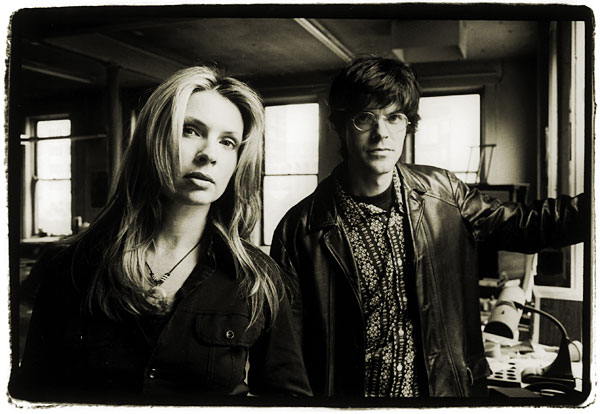
D.M.: You said last night
from the stage that you were on your own personal "Planes,
Trains & Automobiles" adventure. I hope the whole tour
hasn’t been like this.
Linford L.D.: No, the tour’s been great.
D.M.: You call the new
album Films For Radio, and I’ve always
noticed that your music is very cinematic, so I’m
wondering if films may have been your first inspiration,
before music. Or did you start with music, before
receiving inspiration from film?
L.D.: I think these two are kind of tangled up
together, and I can probably credit my sister Grace for
putting me into a mindset where the two are connected.
When my father brought home our first upright piano, I
knew that wooden house was going to be an important part
of the story I was going to write with my life. I started
playing quite a bit as a child, just fooling around and
making up my own music. My then eight-year-old sister
Grace informed me that I had a couple of options when it
came to the piano. I could play the hymns that we were
growing up with, or I could be a concert pianist, which
meant to play the piano for silent movies. We were growing
up without television, so I was very intrigued by this
idea of playing for silent movies. I think somewhere along
the line I came up with the theory, even as a child, that
the movies were inside of us.
D.M.: Did your parents
intentionally not have a television in the house?
L.D.: Yeah.
D.M.: Was this a cause
of frustration for you?
L.D.: I don’t think so. Children who came over
wanting to play with us were typically pretty excited
because our imaginations were a bit more independent. We’d
come up with pretty grandiose schemes. But when we went
over to other peoples’ houses, we immediately put down
roots and wanted to watch whatever was on TV. Ultimately,
I’m glad that we went without television.
D.M.: In interviews,
you talk about the characters singing the songs as being
outside of yourself—that you’re not really speaking for
yourself, always. Do you see them as cinematic episodes or
scenes that you’re creating?
L.D.: Yeah, I do. I’ve always been prone to argue
that I’m not trying to make every song autobiographical,
but as I look back over our last seven or eight records, I
can see that I’ve been working loosely on making sense of
my own life story through this music. And it is probably
all connected in some way.
D.M.: How do you
collaborate with Karin on songs?
L.D.: It changes from song to song. Her songs tend
to land in one piece sometimes. And sometimes I do the
same—I write songs from beginning to end. Other times we
bring unfinished ideas to each other, and work together.
D.M.: My favorite song
on the album is the "Little Blue River," which kind of
reminds me of a Van Morrison song…
L.D.: Oh, you nailed it!
D.M.: You know how he
gets into a mindset and a mood, and he just wants to stay
there as it evolves while he’s singing. I find that it
happens with this song, as well. What inspired that song?
Was there any particular event?
L.D.: Karin was sitting in the passenger seat one
night when we were driving home from Chicago. We crossed
over this little river, The Little Blue River. It just
started happening and she wrote it down. It was probably
six years ago, I think, that she wrote the song. During
that time, we discovered some of those early Van Morrison
records. She spontaneously started connecting part of a
hymn called "In The Garden." I think it was loosely
inspired by the feeling of some of those early Van
Morrison recordings. You tend to get lost in the vibe of
the song and you want to stay there for a while, like you
were saying.
D.M.: Now that you’ve
had some time to live with the album, what are your
feelings about it? I know a lot of songwriters tell me
they don’t always know what their songs are about when
they write them, but after some time, the songs begin to
reveal themselves.
L.D.: I find that to be really true, and I know
exactly what you’re saying. When I write, I seldom have an
agenda in mind. I’ve learned along with everybody else the
various things a song might mean. I think that the songs
that ended up on the record loosely fit together with the
theme. They’re all being sung in the first person. I think
I have–being in my mid-thirties now–enough perspective to
look back on my life. It’s increasingly obvious to me that
we write stories with our lives, with a cast of characters
that wander in and out. Some stay, some leave. We’re the
protagonist and antagonist in our own story. And I think
in all these songs, Karin and I are sort of wrestling with
this idea of how do we live a life worth remembering. How
do we make our life a true story? That’s the way I see the
songs fitting together. There’s a line in the first song,
"The World Can Wait," "Roll the movie of my life inside
of my head." I think that line sums up many of the
songs. In the last song on the record, "When I Go," Karin
is asking the question: "Will it make a difference when
I go?" To me, it’s about thinking about the end of the
story, and what kind of an ending do I want to write. What
is important to me? And does any of this stuff matter.
D.M.: If it were to
end today, what kind of legacy do you think you’ve left?
What are the important things that you’ve left with your
art?
L.D.: I’ve made peace with what I do, and if it all
ended today, I could hang my hat on it and feel good about
the last ten years. I think my legacy is that beauty needs
no justification [laughs]. I see my music as little
splashes of color on a much bigger painting. I may not be
the most important or recognized artist out there by any
means, but I know that what I’ve tried to do is from an
honest place that’s real. I know that people have
connected deeply with what I do. A couple of years ago we
began to see this theme in letters people would write to
us, where we could almost line them up and cover the whole
gamut of human experience. People were saying that they
fell in love to our music. They conceived to our music.
Some of them actually took our records to the hospital and
gave birth with our music playing. People have grown up,
gone to college, and sort of figured out what’s important
to them listening to our music. And a lot of them say our
music helped open them open wider and has given them
perspective. People have written to us and said loved ones
have passed away and our music was instrumental in helping
them get through those difficult times. I began to see,
wow, our music is connecting with people’s experience—from
birth all the way through. What more could we possible ask
for as songwriters?
D.M.: Doesn’t that put
on added pressure?
L.D.: Not at all. It takes the pressure off,
because I realize that if I just try to be true to who I
am and what I believe is important, people are going to
discover that and it’s going to mean something to them. I
don’t have to try to be something that I’m not, in hopes
of gaining wider recognition. I’d rather just try to do
something real, and let the world catch up, if and when
they’re ready.
D.M.: Does it
frustrate you that you haven’t had more commercial success
with your music?
L.D.: Sometimes. I believe in what we do. A lot of
people have had their misadventures with the record
industry. We’ve certainly had ours. Sometimes it feels
like we’re wasting a lot of energy. We're just going to
try to do what we feel is the truest version of what we
do. That doesn’t mean that we won’t occasionally
experiment. We're not going to try to play the game in
terms of having somebody from a major label come in and
reinvent us and shape the vision. We won’t go there.
D.M.: Trying to
understand the music business and make sense of why some
artists have success, while others do not.
L.D.: There are a lot of variables. Some of it, I
think, is a bit random, having things lined up at the
right time. I still think that Over the Rhine will have a
lot of success. We’ve had enough where we’ve been able to
make a living at it for a long time. I’m really grateful
for that, in spite of whether we’re on labels or off
labels. People who have discovered what we do are
tremendously supportive. Regardless of what happens, it’s
been a pretty great ride.
by Dan MacIntosh
|
|
|
|